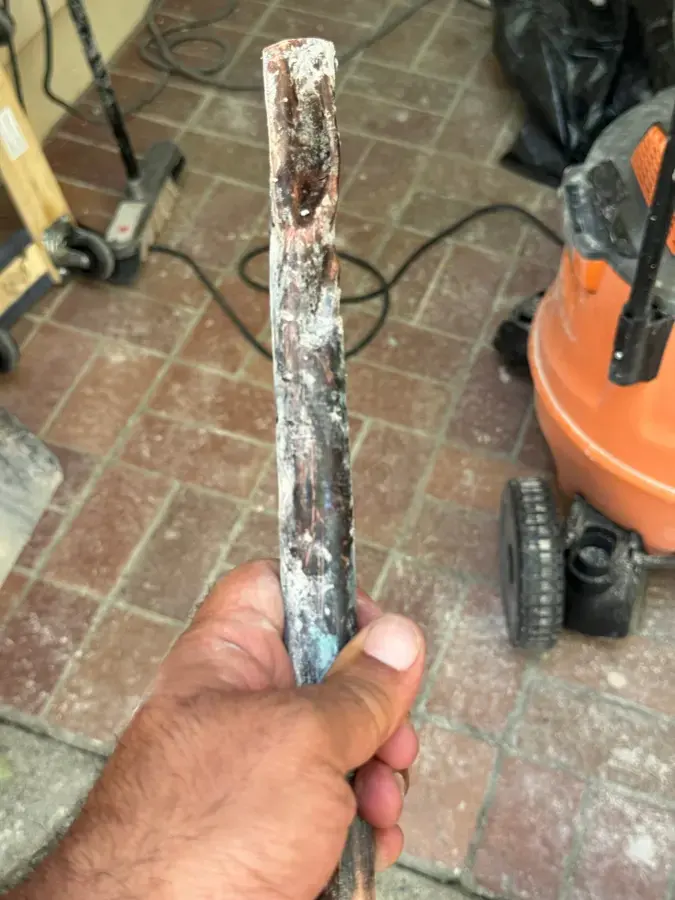
Many Castro Valley homes from the 1950s and 1960s were plumbed with galvanized steel supply pipe. After decades inside walls and under floors, that pipe rusts through in small ways long before it breaks in a big one.
Key takeaways
- Galvanized steel supply pipe is found in many 1950s and 1960s Castro Valley homes, and it fails by rust, pinholes and failed threads.
- A pinhole leak is slow and hidden, so damage is often found weeks after it started.
- Leaks tend to hide in walls, in crawl spaces and under cabinets, where the water has room to spread.
- Meters find the wet area, and the wall or floor is opened only where the readings say.
- A repair of one joint is quick, but a house with several leaks may be better served by a repipe.
Why galvanized pipe fails from the inside
Galvanized steel pipe has a zinc coating meant to slow rust. Over decades that coating wears away from the inside, and rust builds up where the pipe is thinnest.
Water flows more slowly as rust narrows the pipe, and the wall thins until a pinhole opens. Threaded joints and elbows are especially exposed, which is why failed threads show up so often in older homes.
Castro Valley houses from the 1950s and 1960s are the age at which this process has had decades to work. Later houses in the area have copper, which fails differently.
The failure is gradual, so there is rarely a single moment when the pipe is known to be bad. Most owners learn about it from a stain or a plumber's note.
- Pinholes open where rust has eaten through the wall of the pipe.
- Failed threads let water seep from a joint a little at a time.
- Flow and pressure often drop before a leak is found.
- Rust colored water at a faucet can be an early warning.
Where leaks hide in Castro Valley homes
Most Castro Valley houses are 1950s to 1970s ranches and hillside split levels on raised foundations with crawl spaces. That layout gives leaks a lot of places to hide.
A leak in a hidden place can run a long time before anyone notices, which is why the damage is often larger than the leak.
- Inside interior walls, behind a bath or kitchen.
- Under the floor in the crawl space, where pipe runs along the joists.
- Under cabinets, where a slow drip soaks the base.
- Beside the water heater in a garage or hall closet.
- Under the house near a wall that leads to a bathroom above.
Signs of a slow pinhole leak
A pinhole leak seldom shows itself dramatically. The signs are small and cumulative.
Any one of these can be something else, but two or three together point to a hidden leak.
- Water stains that grow slowly on a ceiling or wall.
- Damp, musty smells in a closet or cabinet.
- Warped baseboards and flooring near a bath or kitchen.
- A moist patch on crawl space soil in dry weather.
- A water bill that rises without a change in use.
Tracing the leak
A crew confirms the leak before opening any wall.
Tracing before opening protects the house. A crew that opens walls by guesswork creates more repair work than the leak itself.
Meters and moisture mapping
Moisture meters read walls, floor edges and cabinet bases to map the wet area. A thermal camera adds a second look for cool spots where water is moving.
Opening only where needed
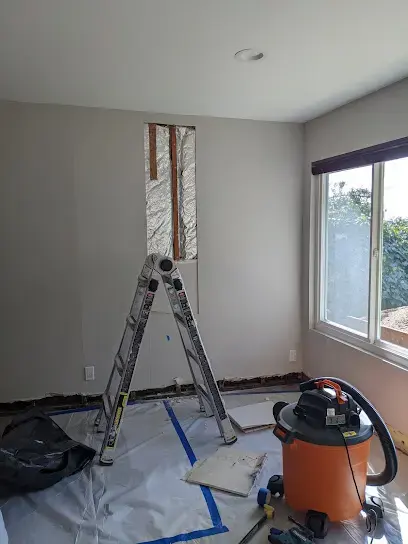
The map shows where to cut. A small opening confirms the pipe and the wet material, and larger openings follow only where readings call for them.
What an owner can note beforehand
A few notes make tracing faster. The more precise the history, the smaller the opening.
- Where the first stain or smell appeared.
- When the bill began to rise.
- Whether the sound of running water comes from one wall or one floor.
- Whether the water pressure has dropped at any fixture.
Patch or repipe
Repairing one joint is fast and cheap. It does not fix the rest of the pipe, which is aging at the same rate.
A single leak found early
A plumber repairs the failed section, and the wet cavity is dried. This suits a house where the rest of the pipe looks sound.
Several leaks or repeated failures
If a second pinhole appears within a short time, the whole system is likely at the same stage. A repipe replaces the supply pipe, usually with copper or another modern material.
Mixed pipe
Many homes have a mix of galvanized steel and later copper. A leak often appears where the two meet.
Questions to ask a plumber
A repipe is a larger job, so a few questions help owners compare options.
- Is the pipe in other parts of the house in the same condition?
- Where does galvanized pipe connect to copper?
- What is the plan for walls and the crawl space during the work?
- Will the cleanup crew need to dry the walls before the new pipe goes in?
Drying the walls, crawl space and subfloor
Once the leak is fixed, the wet materials come next. A galvanized pipe leak cleanup dries the cavity, the cabinet base and the subfloor.
In a crawl space, the same crew checks joists and insulation, and wet insulation is removed. The crawl space water damage page covers that work, and structural drying explains the readings that show when it is finished.
- Insulation that was wet is removed.
- Drywall that stayed wet a long time is removed.
- Solid wood framing is dried in place.
- Cabinet bases and baseboards along the wet wall are checked even if they look dry.
Pinhole or burst, and what insurance may say
A pinhole is a slow leak, while a burst pipe is a sudden one. Insurers often treat them differently, so the time the first sign appeared is worth recording.
Photographs, the plumber's repair note and the final readings make the file complete.
If a house has several rust spots, the plumber's note can show the whole system is at the same stage, which helps explain why a repipe makes sense.
Questions
How long does galvanized pipe last?
It depends on the water and the pipe, and a house from the 1950s or 1960s may still have it. Rust, pinholes and failed threads are the usual signs of the end of its life.
What is a pinhole leak?
A tiny opening where rust has eaten through the wall of the pipe. It leaks slowly and often goes unnoticed for weeks.
Can a pinhole in galvanized pipe be patched?
A single failed section can be repaired, but the rest of the pipe is the same age, so a second leak is a common reason to consider a repipe.
Why is rust colored water a warning sign?
Rust colored water can mean the inside of the pipe is corroding. It is not always a leak, but it signals the pipe is at a late stage.
Does a slow leak damage the house structure?
Yes, if it runs long enough. Wet framing, subfloor and drywall can all be affected, which is why the cavity is dried to a reading after the repair.
Do Castro Valley homes built after the 1960s have galvanized pipe?
Copper became the later standard, so galvanized pipe is most common in 1950s and 1960s homes. A plumber confirms what any particular house has.