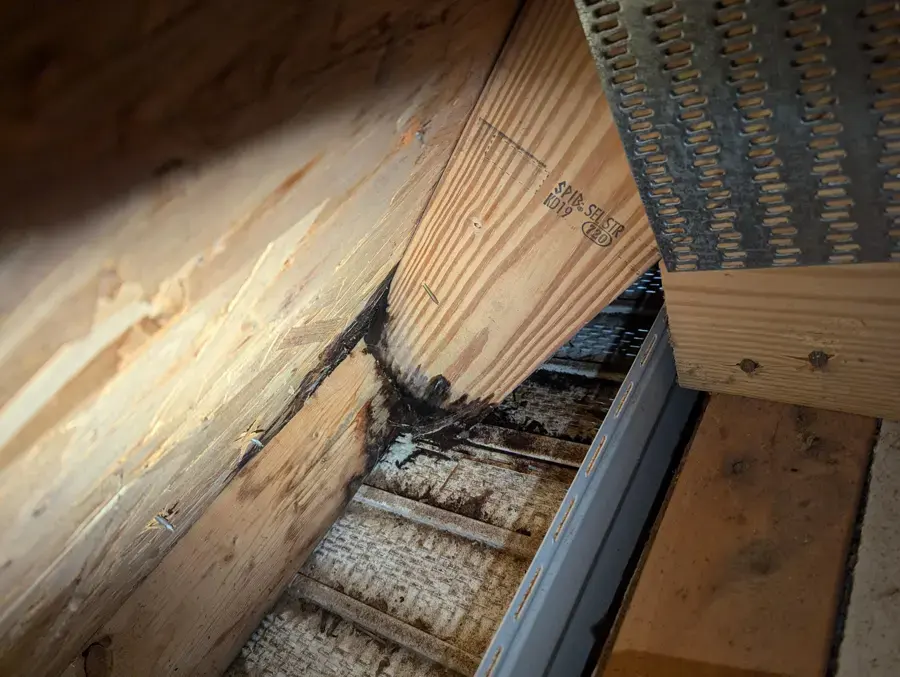
Oakland has a warm summer Mediterranean climate, and nearly all of its rain falls from November to April. When an atmospheric river arrives, the roof takes the first hit and the ceiling takes the second.
Key takeaways
- Rainfall near the Oakland bayfront is about 23 inches a year, against up to 30 inches in the hills, so hill roofs spend more time wet.
- The October 24, 2021 record of 2.02 inches and the 4.75 inches in 24 hours on December 31, 2022 show how much water a roof can face in a single day.
- Roof water usually travels through attic insulation to a ceiling, so a stain below often marks a leak well above it.
- The order of work is tarp, wet insulation, wet ceiling drywall, then drying to readings.
- At the 2010 Census 58.9 percent of Oakland housing units were renter occupied, so a roof leak often involves a landlord as well as an owner.
Two rain bands in one city
Oakland rainfall is not even. Rainfall near the bayfront is about 23 inches a year, while the Oakland Hills can see up to 30 inches.
Almost all of it arrives from November to April, and winter storms include atmospheric rivers that can stay over the Bay Area for days.
A roof in the Oakland Hills carries more rain over a season than one near the bay, and it often carries it on steeper, more exposed slopes.
That is why a leak that never appeared in a mild year can show up in the first big storm of a wet one.
- Hill roofs get more rain and often more wind with it.
- Bayfront roofs get less rain but face the same storm peaks.
- Both are tested hardest by the first big storm after a long dry summer.
- A roof that held through a mild year can still fail in a heavy one.
What two record storms did
Two recent storms show the scale a roof can face in a single day.
October 24, 2021
An atmospheric river gave Oakland a daily record of 2.02 inches of rain, breaking a record from 1951. It arrived early in the wet season, when roofs and gutters had not been tested for months.
December 31, 2022
The Oakland Museum recorded 4.75 inches of rain in 24 hours, its wettest day since records began in 1970. It came during a series of strong storms across the Bay Area.
How roof water travels into a house
A roof leak rarely shows up where it starts. Water enters at a joint, flashing, vent or damaged spot, runs along the roof deck and drops into insulation.
From there it spreads sideways, soaks the ceiling drywall and finally shows as a stain, a bulge or a drip, often far from the entry point.
The leak seen on the ceiling is usually the last stop, so the roof is checked well beyond the stain.
Rain that finds a weak spot can travel a long way before it shows, so a small stain can hide a large wet area.
- Brown or yellow rings on a ceiling that grow after each rain.
- A bulge or sag in the drywall, which means it is holding water.
- Drips from a light fixture or a smoke detector.
- Paint that blisters or peels along a wall and ceiling edge.
- A damp smell in the room below the attic.
The order of work after a roof leak
The sequence is simple and the order matters, because stopping water is not the same as removing it.
Stop the water entering
An emergency tarp covers the damaged section of the roof. This is the same roof leak water damage response used after any storm, and it is meant to hold until a roofer can repair the roof.
Get ahead of the ceiling
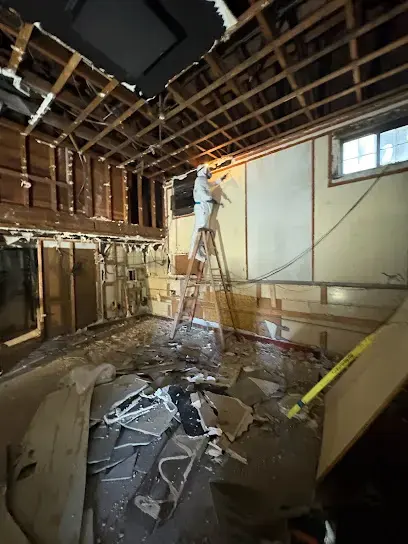
A sagging ceiling is relieved safely, because trapped water can drop all at once. Wet drywall is cut where the meters say it is wet.
Remove what cannot dry
Wet attic insulation is removed, because it holds water against the framing. Ceiling drywall that stayed wet is removed and replaced later.
Dry the structure
Framing, the ceiling cavity and walls below are dried with air movers and dehumidifiers until the readings return to normal. The ceiling leak water damage page covers how rooms below are protected.
Why order matters
Drying a ceiling while the roof is still open only repeats the loss. Tarping first, then removing wet material, then drying, keeps each step from undoing the last.
A roofer then repairs the roof itself, and the drying team confirms the structure is dry before anything is rebuilt.
What an owner can do tonight
The goal is to limit the spread until the crew arrives.
The Oakland water damage pages list the rest of the response for owners and renters.
- Place a bucket under any drip and move furniture out of the way.
- Keep people clear of a bulging ceiling.
- Turn off power to a room if water is coming through a light fixture.
- Photograph the stain, the water and any damaged belongings.
- Do not climb on a wet roof to look for the leak.
Checks before the next atmospheric river
The wet season starts in November, and most of the rain is over by April. A short check in October is worth more than an emergency call in January.
These checks cover the places roof water usually enters.
- Look for lifted or missing shingles, tiles or flashing after a dry summer.
- Clear gutters and downspouts so water leaves the roof edge instead of backing up under it.
- Check roof vents, chimneys and skylights for cracked seals.
- Look in the attic for stains on the underside of the roof deck.
- Keep a record of when the roof was last inspected or repaired.
Roof wear, storm damage and insurance
Insurers often separate sudden storm damage from long term roof wear, so the cause matters. A dated photo record of the first stain helps show when the leak started.
At the 2010 Census, 58.9 percent of Oakland housing units were renter occupied. For renters, the landlord arranges the roof and ceiling repair, while the tenant documents belongings and tells the landlord at once.
The main roof leak water damage page explains how the same response works across the area.
- Keep the roofer's written finding with the cleanup records.
- Ask for moisture readings when the drying ends.
- Note the date and time of the first drip.
Questions
Why do Oakland Hills roofs see more rain than the bayfront?
Rainfall near the bayfront is about 23 inches a year, while the hills see up to 30 inches. The hills see more rain, so hill roofs spend more time wet.
Where does a roof leak actually start?
Usually well above the visible stain. Water enters at a joint, flashing or vent, runs along the roof deck and soaks insulation before it reaches the ceiling.
Should a bulging ceiling be popped?
A bulging ceiling is holding water and can drop without warning. A crew relieves it in a controlled way, so keeping people clear is the safe step until then.
Can wet attic insulation be dried?
Rarely. Wet insulation holds water against the framing for a long time, so it is usually removed and replaced after the structure dries.
Is a roof leak covered by insurance?
It depends on the cause and the policy. Sudden storm damage is often treated differently from long term wear, so the wording matters.
When is the best time to check an Oakland roof?
Before the wet season starts in November. Nearly all of Oakland rain falls from November to April, so a check in the fall finds weak spots before an atmospheric river does.